Alex Schmidt · 20 September 2026
Wind Corridor Utilization for Optimizing Plant Health in Dynamic Dune Gardens
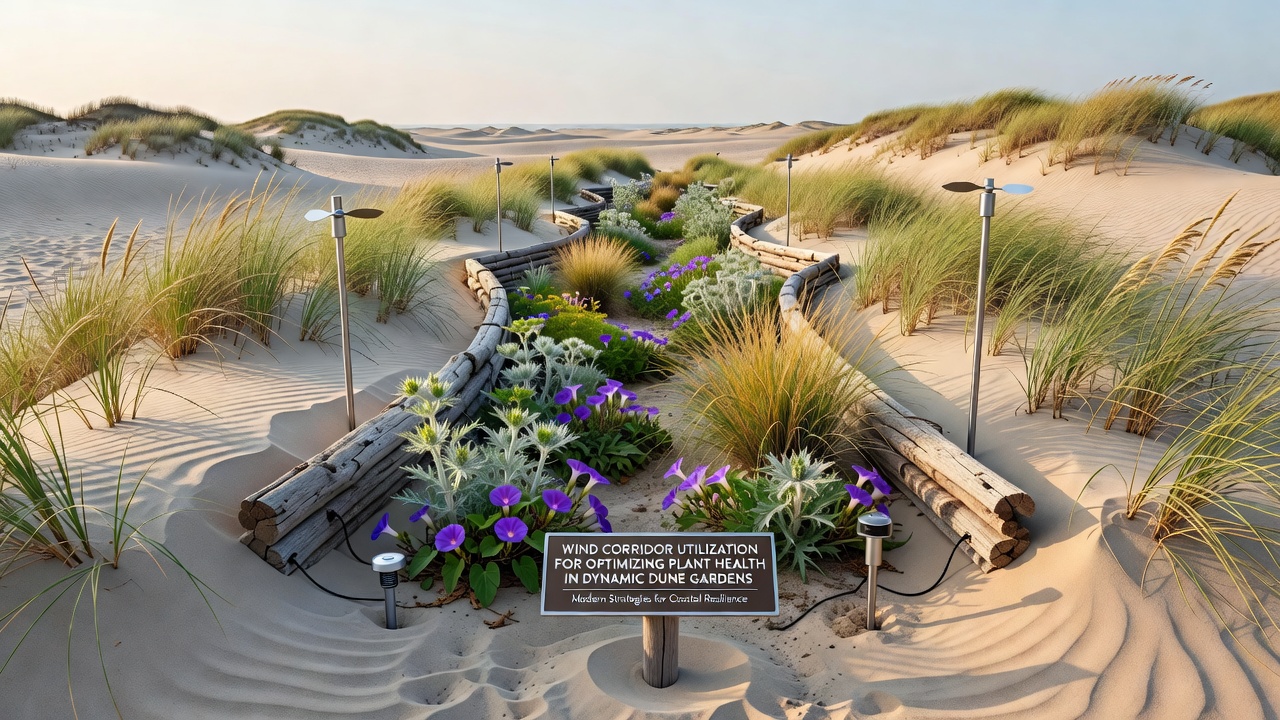
Wind corridors in dynamic dune gardens consist of strategically aligned open spaces that direct prevailing winds through planted zones, and these pathways interact with shifting sands and vegetation to influence microclimates. Observers note that such corridors channel airflow at controlled velocities, which reduces localized turbulence while allowing consistent air movement across plant canopies. Research from coastal ecology programs shows that this managed airflow supports root stability in species such as Ammophila breviligulata and Leymus mollis by limiting excessive sand burial or exposure.
Core Principles of Wind Corridor Design
Designers calculate corridor width and orientation according to regional wind rose data, and they align these spaces parallel to dominant wind directions during the growing season. Data from the U.S. Geological Survey coastal monitoring networks indicate that corridors measuring 3 to 6 meters wide maintain wind speeds between 2 and 5 meters per second at canopy height, a range that promotes evapotranspiration without causing desiccation. Plants positioned along corridor edges receive enhanced carbon dioxide exchange, while interior zones benefit from moderated gusts that prevent mechanical damage to stems and leaves.
Soil moisture retention improves when corridors are spaced to avoid funneling effects that accelerate evaporation, and studies conducted across Pacific Northwest dune systems demonstrate measurable differences in volumetric water content between corridor-adjacent plots and fully sheltered areas. Vegetation within these configurations develops deeper root networks because periodic air movement stimulates physiological responses that enhance nutrient uptake from sandy substrates.
Plant Health Outcomes Linked to Airflow Management
Air circulation through corridors limits the duration of leaf surface wetness, and this reduction correlates with lower incidence of foliar pathogens in monitored dune plant communities. Figures from long-term vegetation surveys reveal that plots incorporating wind corridors exhibit 15 to 25 percent fewer cases of rust and leaf spot diseases compared with dense, unventilated plantings. Pollinator access also increases because steady airflow carries floral scents farther, resulting in higher visitation rates recorded by field researchers in restored sites.
Dynamic dune gardens experience seasonal sand movement, yet corridors help distribute fine particles evenly rather than allowing accumulation against plant bases. This even distribution prevents anaerobic conditions around roots and maintains oxygen diffusion into the rhizosphere. In September 2026, monitoring stations along the Atlantic coast documented improved photosynthetic rates in corridor-managed sections during late-summer heat events, when surrounding unstabilized areas showed signs of stomatal closure due to heat buildup.

Implementation Across Different Coastal Regions
Projects in the Baltic Sea region have adapted corridor designs to prevailing westerly winds, and these installations integrate low-profile barriers made from biodegradable materials to fine-tune wind speed at ground level. Data compiled by the European Environment Agency coastal working group shows that such adaptations maintain sediment transport rates within natural variability while supporting higher plant cover percentages. In Australian coastal reserves, similar corridors oriented to seasonal trade winds have been paired with native spinifex species, producing documented gains in dune crest stability over multi-year observation periods.
Maintenance protocols involve periodic assessment of corridor alignment because vegetation growth can gradually narrow pathways and alter intended airflow. Technicians use portable anemometers to verify that wind speeds remain within target ranges, and adjustments consist of selective pruning or sand redistribution rather than major reconstruction. These practices keep the system responsive to changing wind patterns without disrupting established plant communities.
Monitoring Techniques and Data Collection
Researchers deploy arrays of low-cost sensors along corridor transects to record continuous wind velocity, humidity, and temperature gradients, and the resulting datasets allow comparison between corridor-influenced zones and control areas. Satellite imagery combined with ground-truth surveys tracks changes in vegetation density and sand elevation, providing quantitative evidence of corridor effectiveness over time. One study from the Helmholtz Centre for Environmental Research examined corridor performance across multiple dune sites and found consistent patterns of reduced erosion along corridor margins when initial widths matched local wind regimes.
Seedling establishment rates serve as another indicator of corridor success, because young plants benefit from the moderated microclimate that corridors create. Counts conducted in restored gardens show higher survival percentages for seedlings placed within 2 meters of corridor edges during the first two growing seasons. These measurements help refine spacing guidelines for future installations and confirm that airflow management contributes measurably to overall garden resilience.
Conclusion
Wind corridor utilization integrates airflow management with the natural dynamics of dune systems, and the approach yields measurable improvements in plant health metrics across varied coastal environments. Continued data collection from established sites supplies the evidence base for refining design parameters, while regional adaptations demonstrate the flexibility of the method. As monitoring expands, the role of corridors in sustaining vegetation under shifting wind and sand conditions becomes increasingly clear through accumulated field records.